

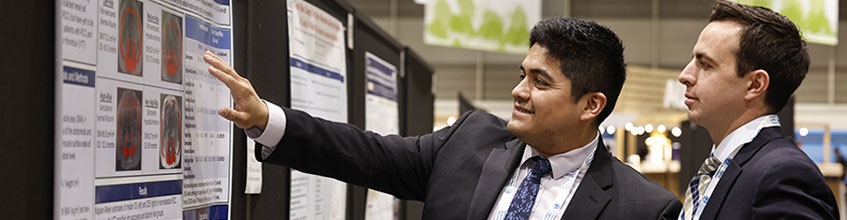
About the Program
Clinical Trials in Progress sessions are designed to increase awareness of important clinical trials that are either ongoing or in the late design phase. These trials should not be completed and there is no expectation that data will be presented. Accepted abstracts will describe studies that are expected to substantially influence practice when they are ultimately reported and/or published.
Trials that are accepted will be featured in the Learning Lab, which showcases engaging presentations at AUA2027. This venue is adjacent to the Science & Technology Hall and attracts a robust attendance.
|
Important Dates |
|
|---|---|
|
Submission Site Opens |
November 9 |
|
Submission Deadline |
January 22, Noon EST |
Eligible Studies
Investigators can present ongoing industry-sponsored or investigator-initiated independent studies that are about to open, currently accruing participants, or in follow-up. Submissions should describe the trial's purpose, design and eligibility criteria, but have not reported primary findings. There is no expectation that preliminary data will be presented.
Submission Guidelines
Submissions must contain the following elements. Character limits include spaces.
- Title (255 characters)
- Body organized in two sections:
- Background (1,000 characters): Scientific rationale for the trial, a brief description of interventions, and correlative studies of particular interest
- Methods (1,000 characters): Trial design and statistical methods, highlighting any new features; treatment or interventions planned; major eligibility criteria, highlighting any unusual aspects; current enrollment status, without providing results or endpoints. Phase II and III studies must state how many patients have been enrolled out of the planned total. Phase III trials may state when the data monitoring committee last reviewed the trial and what it recommended
- Clinical trial registry number
- Funding (255 characters)
Do not include the following:
- Preliminary data or results
- Information about pricing, fees, or reimbursement related to trial participation
Additional Guidance
Use of Product Names: Only generic drug names should be used unless no generic exists. If a trade name must be used it must be in parentheses directly after generic name. Device trade names should be used only when comparing available options. In other instances, the device product class or functional name should be used.
Abbreviations: Place abbreviations in parentheses immediately after the first mention of a term or phrase; the abbreviation can then be used throughout the abstract.
References: In text citations should be used for any references. Any referenced research must meet accepted scientific standards in design and analysis. Authors must not cite studies with known allegations of misconduct.
Figures/Images (Optional)
Authors who wish to include a figure or table with their abstract must upload the file as an image. Up to two images may be included with the abstract. JPEG and PNG files are acceptable.
Authors
There is no limit to the number of authors included in an abstract. One author must be designated as the presenter.
The submitter must enter the following information for each author (* denotes a required field).
- First name*
- Middle initial or name
- Last name*
- Suffix
- Email*
- AUA ID
- Primary institution/organization*
- Department
- City*
- Country*
- If U.S. is selected, state/territory is required
- If Canada is selected, province/territory is required
Submission Categories
- Adrenal
- Benign Basic Science Research
- Benign Prostatic Hyperplasia
- Bladder & Urethra: Anatomy, Physiology & Pharmacology
- Bladder Cancer
- Health Services Research
- Imaging/Uroradiology
- Infections/Inflammation/Cystic Disease of the Genitourinary Tract
- Infertility
- Kidney Cancer
- Pediatrics
- Penile and Testicular Cancer
- Prostate Cancer
- Sexual Function/Dysfunction
- Stone Disease
- Surgical Technology & Simulation
- Transplantation & Vascular Surgery
- Reconstruction
- Urodynamics/Lower Urinary Tract Dysfunction/Female Pelvic Medicine
Submission Policies
Duplicate or Similar Abstracts
Duplicate or similar abstracts derived from the same study or covering closely related clinical subjects should be combined into a single abstract. The submission of multiple abstracts from a single study may lead to the rejection of one or more abstracts
Previously Presented or Published Abstracts ("Encores")
Prior to the AUA Annual Meeting, the contents and conclusions of the abstract must not have been presented at or published in conjunction with any scientific, medical, or educational meeting with the following exceptions:
- Abstracts previously accepted to AUA Section meetings or select urologic sub-specialty societies are eligible for submission even if presented or published under the scientific, medical, or educational outlets of those meetings. Authors are strongly encouraged to provide updated data in the abstract submitted to the AUA Annual Meeting.
- Study results may be presented at closed (non-public) meetings on the condition that no meeting materials are publicly disseminated in any format.
Additionally, the contents and conclusions must not be published as a full-length research article in a scientific, medical, or educational publication (in any medium), in whole or in part, before the abstract is published online by the AUA. Full-length pre-prints (non-peer-reviewed research articles published online for public dissemination and public comments are permitted before the abstract is submitted.
Restrictions on the Use of Artificial Intelligence
The AUA requires anyone who is in a position to control the content of an AUA educational activity [e.g. scientific program directors, faculty presenters, speakers, moderators, program planners, contributors, editors, reviewers, and presenting authors] to abide by the following policies:
- I agree that I will refrain from using, sharing or uploading content I accessed through AUA websites or educational activities into external applications, bots, software, or websites, including those using artificial intelligence technologies and infrastructure, including deep learning, machine learning and large language models and generative AI.
- I agree that I will refrain from using or sharing any AUA content/data to train, alter, inform, or otherwise affect any form of artificial intelligence; deep learning; machine learning; or similar automated, autonomous, self-improving, or otherwise adaptive software model or program (whether automated as a whole or in part).
- In providing presentation(s), handouts, and related materials, I agree to only use AI tools for the following purposes: idea generation and general knowledge questions and research meant to enhance my understanding on a topic. I will not use AI tools to create final work product including, but not limited to, the presentation, handouts, related materials, content, and deliverables, with the exception of images, charts, drawings or similar graphics meant to enhance the presentation. If an image, chart, drawing or similar graphic is utilized, it must be properly cited.
- I represent and warrant that my Presentation is my (and/or my-co-presenters') original creation, and if utilizing another organization or individual's content into external applications, bots, software, or websites, I/we have obtained all necessary permissions and/or licenses to use and license the text, images and all content within this Presentation.
Revisions
Prior to the submission deadline, the submitter may log in to view, edit or delete an abstract. It is the responsibility of the submitter to ensure the abstract is complete and free of errors. After the submission deadline, revisions to the abstract content including authorship, will not be accepted.
Withdrawal
Requests to withdraw an abstract may sent by the submitter or presenting author to annualmeeting@AUAnet.org. Please include the submission ID and title in your request.
Review Criteria
Submissions will be evaluated on the following criteria:
- Strength of Science – Does the trial address an important and new question?
- Trial Design – Are the eligibility criteria, study endpoints, and planned analysis well-defined?
- Collaboration – Is there potential for investigator collaboration?
- Relevance – Will the results be relevant and of interest to the AUA Annual Meeting community?
Trials Accepted for Presentation
Registration Requirement
The principal investigator/presenter must attend the 2027 AUA Annual Meeting in San Diego, CA. The presenting author is required to respond to the invitation to present by the date indicated in the acceptance letter. Failure to register by this date will forfeit the opportunity to present and the trial will be withdrawn from publication in The Journal of Urology®.
The presenter is responsible for any expenses associated with the preparation, submission and presentation of the abstract. Registration fee waivers and travel grants are not available for presenters.
Presentation
Clinical Trials in Progress accepted for presentation will be scheduled in the Learning Lab according to topic category. The principal investigator will have approximately 10 minutes to present and take questions from the audience.
At the time of acceptance notification, details will be communicated regarding the date and time of presentation along with guidance and expectations.
Publication
Abstracts accepted for the Annual Meeting are copyrighted by the American Urological Association and published in a supplement of The Journal of Urology® on the first day of the Annual Meeting. No part of materials published in The Journal of Urology® may be reproduced without written permission of the publisher. For information on requesting permission to reuse The Journal of Urology®, visit shop.lww.com/journal-permission or contact publications@AUAnet.org.
Contact
Questions regarding the submission process may be sent to the annual meeting programs team at annualmeeting@AUAnet.org.